



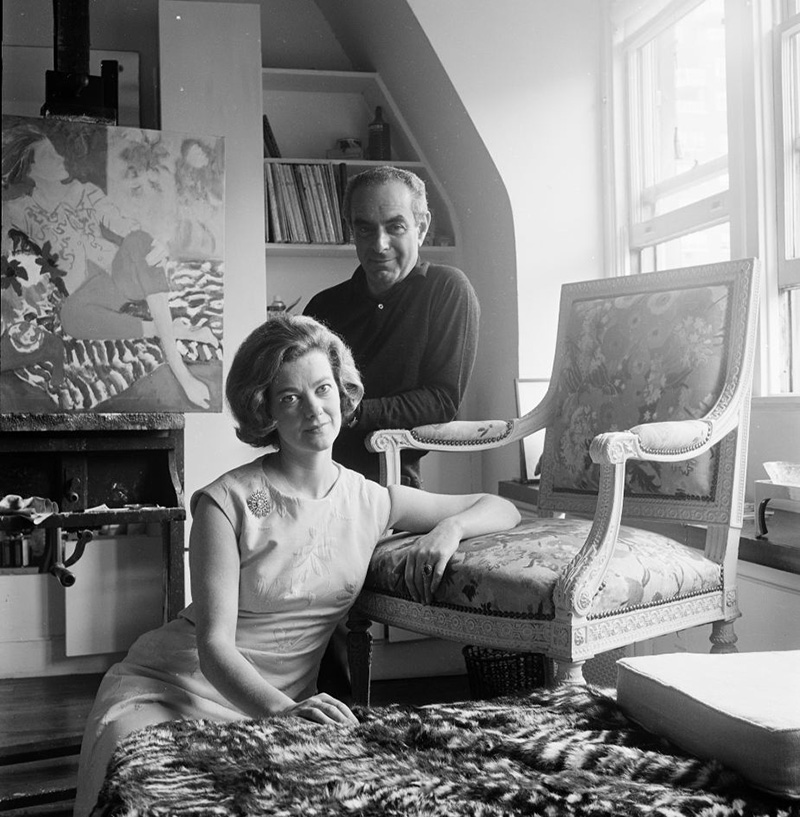
Born in Paris and raised in England, Denise Lawson-Johnston arrived in America with her family just after the battle of Dunkirk in 1940.
Much of Denise’s life revolved around the worlds of high fashion and fine art, she worked at Harper’s Bazaar under Carmel Snow and later became a jewellery editor at American Vogue working under both Jessica Andrews and Diana Vreeland. It was at Vogue in 1956 that Denise first met René Bouché, then at the height of his fame as a fashion artist and portrait painter.
Denise quickly became René’s favourite subject, elegant, sample sized & with a passion for haute couture she soon began appearing frequently in his published fashion drawings. Denise wore Balenciaga with flair and was even fitted for a hat by Mizza Bricard at Dior. Their engagement was announced in the New York Times on the 19th of April and they married in London on the 20th of June 1962. Tragically, René died 13 months later leaving behind a vast collection of drawings and paintings documenting the golden age of Haute Couture.
Denise curated a number of exhibits celebrating René’s work while continuing to lend her support to new and emerging artists. She worked with Gallerist Alexander Iolas, was photographed by Robert Mapplethorpe and fundraised for both the Cooper Hewitt and Guggenheim Museums. Denise also remained a firm fixture on the international social scene, attending Truman Capote’s famous black and white ball in a mask designed by Yves Saint Laurent.
In 1994 Denise married George Hopper Fitch, a patron of the Fine Arts Museums of San Francisco and the Yale Galleries. After his death Denise continued to serve on the Boards of both institutions, supporting numerous exhibits of the designers she admired such as Cristóbal Balenciaga and Oscar de la Renta.
Denise donated many of Bouché’s most famous portraits to the National Portrait Gallery-Smithsonian Institution. In 2012 she gifted a portfolio of René’s drawings to the Legion of Honour Museum in San Francisco. This donation became the basis of the most personal presentation of his work, René Bouché: Letters from Post-War Paris.